




Living Kidney Donation
The types of living kidney donation:

- Directed Donation: Donate a kidney to someone who you know needs a transplant.
- Kidney Paired Donation: If you are not a match with the person you want to donate to, you can join a national program through Canadian Blood Services. Donors are matched across multiple pairs, sometimes creating a chain of transplants, so you can help multiple people find a compatible kidney, including your recipient.
- Non-Directed Anonymous Donation: Donate a kidney to someone as part of a paired donation, in your local transplant program, or to a person in need at the top of Ontario’s transplant waiting list.
Risks and Recovery
- Not all transplants are successful.
- Most kidney donations are done using keyhole surgery (small cuts instead of a large cut).
- Donors need to be in good health. The donor and the person receiving the kidney each have their own care team. The living donor program checks each donor carefully to make sure it is safe for them to donate.
- The evaluation requires multiple visits to the hospital and how long it takes can vary based on the patient and living donor program.
- Recovery takes approximately 6-8 weeks.
- Although there is a reimbursement program for costs associated with donation (PRELOD), not all expenses may be covered.
To be a living kidney donor in Ontario:
- You must be at least 18 years old (there is no strict upper age limit for donating in Canada if the donor is in good health).
- You must not have certain diseases, for example:
- kidney disease
- heart disease, or must not have had a heart attack, or stroke in the past
- cancer (other than mild skin cancer) that has not been cured
- You must not be pressured or paid by anyone to donate your kidney.
- Meeting the basic requirements is just the first step. Living donor programs review each potential donor carefully to make sure donation is safe and appropriate.

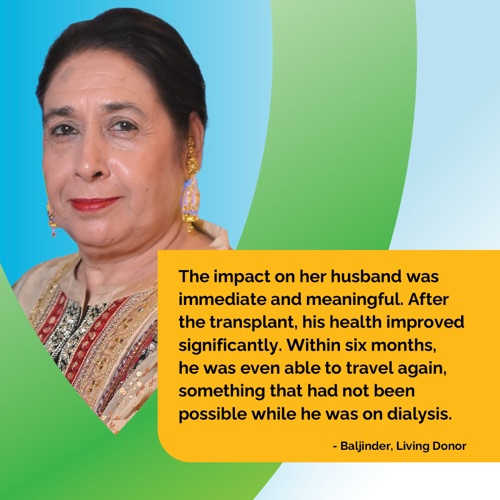
BALJINDER
Baljinder's husband had been on dialysis for about a year and she spent most of this time undergoing tests as part of the living donor evaluation process. She later found that she was the perfect candidate to give her husband the greatest gift...
Program Information
- University Health Network – Toronto General Hospital
- Phone: 416-340-5400
- E-mail: livingorgandonation@uhn.ca
- Unity Health Toronto - St. Michael’s Hospital
- Phone: 416-867-3676
- E-mail: LiveDonorTeam@smh.ca
- Hospital for Sick Children – Toronto
- Please contact the team at University Health Network – Toronto General to be evaluated as a living donor on behalf of a child at Hospital for Sick Children.
- London Health Sciences Centre
- Phone: 519-663-3552
- E-mail: livingkidneydonation@lhsc.on.ca
- St. Joseph’s Healthcare Hamilton
- Phone: 905-522-1155 ext. 32156
- E-mail: livingdonors@stjoes.ca
- Kingston Health Sciences Centre
- Phone: 613-549-6666 ext. 67028
- E-mail: LivingDonor@kingstonhsc.ca
- The Ottawa Hospital – Riverside Campus
- Phone: 613-738-8400 ext. 82719
- E-mail: livingkidneydonor@toh.ca
If you know a person who needs a kidney transplant, you can talk to them and contact the living donor program at the hospital where they are receiving transplant care.
If you would like to become a non-directed anonymous donor, contact a living donor program closest to you for more information.
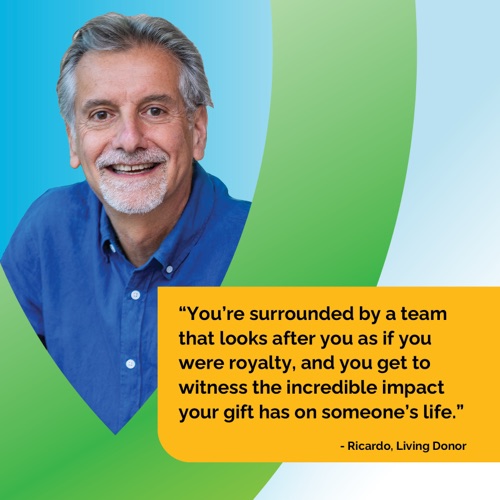
Ricardo
When Ricardo discovered his brother-in-law needed a kidney transplant, he and his family did not hesitate to step forward. “How can you not try?” Ricardo recalls, describing the moment he and his wife decided to pursue living donation, despite knowing little about transplants.
Additional Resources
- Program for Reimbursing Expenses of Living Organ Donors (PRELOD) provides reimbursement to living organ donors and potential living organ donors for eligible out-of-pocket expenses and lost income during the assessment and surgery periods of the organ donation process.
- Transplant Ambassador Program - Transplant Ambassadors are kidney transplant recipients or living kidney donors who welcome the opportunity to share their personal experiences with you, to help guide you through your kidney journey.
- Kidney Foundation Peer Support Program - is an opportunity for people affected by kidney disease to talk to others who’ve been there too. The program is free, confidential, and is there to help anyone touched by kidney disease.
Living Liver Donation
Living donor liver transplantation occurs when a healthy individual donates a portion of their liver to a person with end-stage liver disease. The donor’s remaining liver regenerates and within 12 weeks after the surgery the remaining liver grows back.
To be a Living Liver Donor:

- You must be between the ages of 16 and 60 years old (18-55 for London Health Sciences Centre) and donate voluntarily.
- You must not have:
- diabetes or other long-term, chronic illness
- recent history of cancer (other than mild skin cancer)
- BMI greater than 35 kg/m2
- history of heart bypass surgery, heart attack, cardiac stents or a stroke.
- history of active hepatitis B or C
- HIV infection
- current alcohol or substance use disorder
Risks and Recovery
- Not all transplants are successful.
- Liver donation is a major operation; though living donors are in good health, there are risks related to having surgery. The donor team will talk to you about the risks involved.
- The evaluation requires multiple visits to the hospital and how long it takes can vary based on the patient and living donor program.
- Recovery takes at least 6 weeks.
- Although there is a reimbursement program for costs associated with donation (PRELOD), not all expenses may be covered.
STÉPHANE
Towards the end of 2024, Stéphane noticed a post in the Ottawa area about a friend of a friend in need of a liver transplant. He submitted his information and offered to donate. He wasn’t a match for the intended recipient, but he was a match for an 11-year-old child...

Program Information
University Health Network (UHN)
UHN Living Liver Donor Program
- Phone: 416 340 4800 ext. 6581
- Email: livingdonorliver@uhn.ca
London Health Science Centre (LHSC)
LHSC Living Liver Donation Program
- Phone: 519 685 8500 ext. 33552
- Email: livingliverdonation@lhsc.on.ca
Additional Resources
- Program for Reimbursing Expenses of Living Organ Donors (PRELOD) provides reimbursement to living organ donors and potential living organ donors for eligible out-of-pocket expenses and lost income during the assessment and surgery periods of the organ donation process.